The Method Study And Stability Testing on Liquid Probiotic Products at CV. Pradipta Paramita, Karanganyar Regency, Central Java
DOI:
https://doi.org/10.62521/t6rb6c18Keywords:
Encapsulation, TPC, maltodextrin, Guar gum, BacillusAbstract
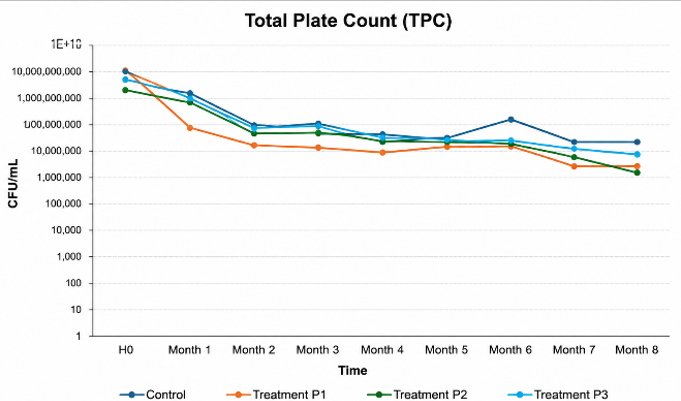
Evapond Bacillus is a liquid probiotic product developed to enhance the health of fish and shrimp. Maintaining its quality can be achieved through encapsulation using coating materials. This study applied an experimental method with three treatments and one replication. The encapsulation material concentration was set at 10% of the liquid volume, with variations in the ratio of maltodextrin and guar gum, namely (70%:30%), (50%:50%), and (60%:40%), each prepared in 100 ml of water. The experiment was conducted for two months to evaluate product stability after encapsulation. The results showed that the combination of maltodextrin and guar gum did not significantly affect the stability of Evapond Bacillus. However, the (60%:40%) ratio demonstrated relatively better performance compared to other treatments. These findings indicate that although the differences were not statistically significant, certain compositions may provide more favorable outcomes. Further studies are recommended using additional or alternative encapsulation materials to obtain more optimal and applicable results.
Downloads
References
Abbas, M. S., Afzaal, M., Saeed, F., Jianfeng, L., Ahmad, A., Ullah, Q., Elahi, S., Ateeq, H., Shah, Y. A., Nouman, M., Shah, M. A., Afzaal, M., & Saeed, F. (2023). Probiotic viability as affected by encapsulation materials: Recent updates and perspectives. International Journal of Food Properties, 26(1), 1324–1350. https://doi.org/10.1080/10942912.2023.2213408
Arroyo-Moreno, S., Saiz-Gonzalo, G., McSweeney, S., & Bleiel, S. B. (2025). Probiotic viability reconsidered: Integrating VBNC resuscitation and culture-independent methods for accurate probiotic enumeration. Microorganisms, 13(11), 2479. https://doi.org/10.3390/microorganisms13112479
Awotundun, T., & Olanbiwoninu, A. (2025). Probiotic potential of riboflavin-overproducing Bacillus subtilis ACU-I163MR and ACU-I11MR, isolated from fermented African locust beans. Access Microbiology, 7(1), 000883-v3. https://doi.org/10.1099/acmi.0.000883.v3
Caulier, S., Nannan, C., Gillis, A., & Licciardi, F. (2019). Overview of the antimicrobial compounds produced by members of the Bacillus subtilis group. Frontiers in Microbiology, 10, 302. https://doi.org/10.3389/fmicb.2019.00302
Gao, H., Li, P., Xu, X., Zeng, Q., & Guan, W. (2018). Research on volatile organic compounds from Bacillus subtilis CF-3: Biocontrol effects on fruit fungal pathogens and dynamic changes during fermentation. Frontiers in Microbiology, 9, 456. https://doi.org/10.3389/fmicb.2018.00456
Hairani, A., & Meryandini, A. (2024). Daya simpan probiotik bakteri asam laktat asal larva black soldier fly terenkapsulasi. Jurnal Ilmu Nutrisi dan Teknologi Pakan, 22(1), 23–28. https://doi.org/10.29244/jintp.22.1.23-28
Ismanto, H. (2023). Organoleptic test of shrimp chips (Litopenaeus vannamei) using vacuum frying. AGS Journal, 6(2), 53–58. https://doi.org/10.51589/ags.v6i2.3137
Ji, C. M., Xu, H. N., & Wu, W. (2009). Guar gum as potential film coating material for colon-specific delivery of fluorouracil. Journal of Biomaterials Applications, 23(4), 311–329. https://doi.org/10.1177/0885328208089617
Katona, G., Korčok, D. J., Tršić-Milanović, N. A., & Jovanović-Lješković, N. M. (2023). Improving the stability of a probiotic product with Lactiplantibacillus plantarum 299v by introducing flow pack bags. Hemijska Industrija, 77(2), 129-136. https://doi.org/10.2298/HEMIND220502011K
Khorasgani, R., & Ph, D. (2023). Preliminary in vitro assessment of probiotic properties of Bacillus subtilis GM1, a spore-forming bacteria isolated from goat milk. Iranian Journal of Veterinary Research, 24(1), 65–73. https://doi.org/10.22099/ijvr.2023.43891.6441
Makete, G., Aiyegoro, O. A., & Thantsha, M. S. (2017). Isolation, identification and screening of potential probiotic bacteria in milk from South African Saanen goats. Probiotics and Antimicrobial Proteins, 9(3), 246-254. https://doi.org/10.1007/s12602-016-9247-5
My, T. T., Lien, N. T., Van Anh, N. T., & Anh, N. H. (2022). 2. Stability and safety study of liquid-suspension Bacillus clausii spore probiotics (livespo clausy). Tạp chí Nghiên cứu Y học, 154(6), 10-19.. https://doi.org/10.52852/tcncyh.v154i6.700
Novelina, N., Syukri, D., & Khairani, M. (2025). Encapsulation of Dadih with Maltodextrin and Gum Arabic: Effect on Nutritional and Sensory Properties of Probiotic Instant Milk. Journal of Agri-Food Science and Technology, 6(3), 152-160. https://doi.org/10.12928/jafost.v6i3.12910
Pinto, N., Barro, R., Franceschi, E., Zeni, J., Hassemer, G. D. S., Junges, A., Backes, G. T., Colet, R., Mignoni, M., & Valduga, E. (2021). Microencapsulation of probiotic Lactobacillus helveticus with different wall materials by spray drying. Biointerface Research in Applied Chemistry, 11(4), 11221–11232. https://doi.org/10.33263/BRIAC114.1122111232
Pitt, T. L., & Barer, M. R. (2012). Classification, identification and typing of micro-organisms. Medical Microbiology, 24–38. https://doi.org/10.1016/B978-0-7020-4089-4.00018-4
Puligundla, P., Jung, J., & Ko, S. (2012). Carbon dioxide sensors for intelligent food packaging applications. Food Control, 25(1), 328–333. https://doi.org/10.1016/j.foodcont.2011.10.043
Rafsyanzani, M. M., & Hidayatullah, D. (2016). Performance of Bacillus sp. probiotic in catfish juvenile (Clarias sp.) infected by Aeromonas hydrophila. Jurnal Akuakultur Indonesia, 15(2), 162–170. https://doi.org/10.19027/jai.15.2.162-170
Rizki, Z., Fitriana, F., & Jumadewi, A. (2022). Identifikasi jumlah angka kuman pada dispenser metode TPC (Total Plate Count). Jurnal SAGO gizi dan kesehatan, 4(1), 38-43. https://doi.org/10.30867/gikes.v4i1.1052
Sebastian, M., Arun, D., Neethu, S., Radhakrishnan, E. K., & Jyothis, M. (2023). Probiotic Paenibacillus polymyxa HGA4C and Bacillus licheniformis HGA8B improved growth performance, enzymatic profile, and disease resistance in Oreochromis niloticus. Microbial Pathogenesis, 174, 105951. https://doi.org/10.1016/j.micpath.2022.105951
Sumanti, D. M., Lanti, I., Hanidah, I.-I., Sukarminah, E., & Giovanni, A. (2016). Effect of skim milk and maltodextrin concentration as coating materials on the viability of microencapsulated Lactobacillus plantaru. Indonesian Journal of Food Research, 1(1), 7–13. https://doi.org/10.24198/jp2.2016.vol1.1.02
Tarlak, F. (2023). The use of predictive microbiology for the prediction of the shelf life of food products. Foods, 12(24), 4461. https://doi.org/10.3390/foods12244461
Wang, G., Chen, Y., & Xia, Y. (2022). Characteristics of probiotic preparations and their applications. Foods, 11(16), 2472. https://doi.org/10.3390/foods11162472
Downloads
Published
Issue
Section
License
Copyright (c) 2026 Alzahni Meila Putri, Ren Fitriadi, Agnes Heratri, Maghfira Selia Irawati, Kamilatun Nisa' Agustina

This work is licensed under a Creative Commons Attribution-ShareAlike 4.0 International License.