The Effect of Shrimp Pond Solid Waste Utilization on Protein and Chlorophyll Content in Caulerpa lentillifera Cultivation
DOI:
https://doi.org/10.62521/4m8gx056Keywords:
Caulerpa lentillifera , Chlorophyll , Protein , Solid Waste , Shrimp PondAbstract
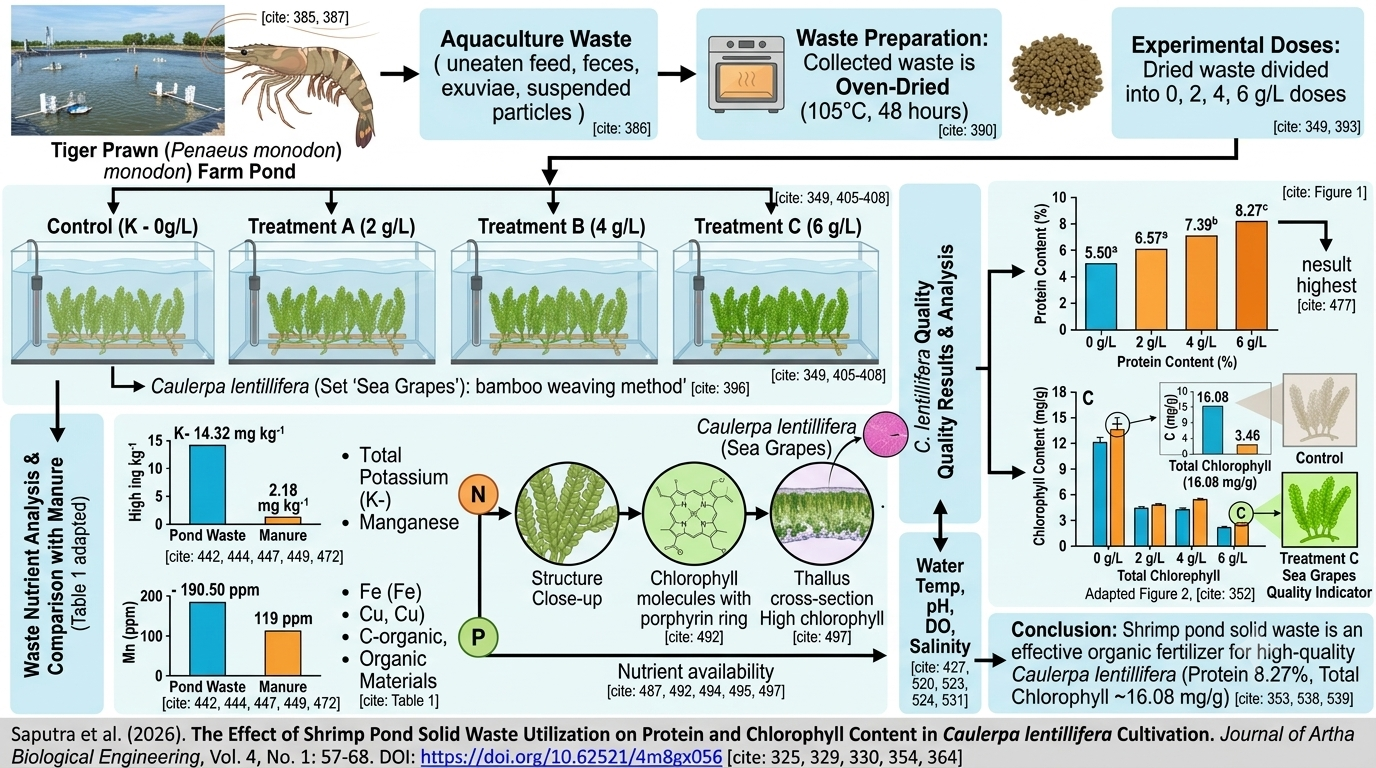
Aquaculture waste is material produced by fish or shrimp farming that can pollute aquatic environments if not promptly managed. The solution to solve this problem is to utilize shrimp pond solid waste as organic fertilizer. The shrimp pond solid waste will be used as fertilizer to cultivate Caulerpa lentillifera. Caulerpa lentillifera cultivation has begun to develop in Indonesia because, in addition to being edible fresh, it also contains good nutrition for the body. This study aims to determine the effect of shrimp pond solid waste on protein and chlorophyll levels of Caulerpa lentillifera. This study was conducted with 4 (four) treatments in the form of different doses of shrimp pond waste (0, 2, 4, and 6 g/L) and 3 (three) replications in each treatment. The parameters tested included nutrient, protein, and chlorophyll content, as well as water quality, in Caulerpa lentillifera cultivation. The results obtained from this study are Caulerpa lentillifera is able to utilize the nutrient content in shrimp pond solid waste as fertilizer to add nutrients. Treatment C had the highest effect with protein content (8.27%) and chlorophyll-a (3.46 mg/g), chlorophyll-b (7.41 mg/g); and total chlorophyll (16.08 mg/g) in Caulerpa lentillifera. Based on these data, it can be seen that shrimp pond solid waste can be used as fertilizer in the cultivation of Caulerpa lentillifera.
Downloads
References
Arnon, D. I. (1949). Copper enzymes in isolated chloroplasts. Polyphenoloxidase in Beta vulgaris. Plant Physiology, 24(1), 1–15. https://doi.org/10.1104/pp.24.1.1
Bambaranda, B. V. A. S. M., Tsusaka, T. W., Chirapart, A., Salin, K. R., & Sasaki, N. (2019). Capacity of Caulerpa lentillifera in the removal of fish culture effluent in a recirculating aquaculture system. Processes, 7(7), Article 440. https://doi.org/10.3390/pr7070440
Bray, R.H. and Kurtz, L.T. (1945). Determination of total organic and available forms of phosphorus in soils. Soil Science. 59: 39−45.
Cai, J., Lovatelli, A., Aguilar-Manjarrez, J., Cornish, L., Dabbadie, L., Desrochers, A., Diffey, S., Garrido Gamarro, E., Geehan, J., Hurtado, A., Lucente, D., Mair, G., Miao, W., Potin, P., Przybyla, C., Reantaso, M., Roubach, R., Tauati, M., & Yuan, X. (2021). Seaweeds and microalgae: An overview for unlocking their potential in global aquaculture development (FAO Fisheries and Aquaculture Circular No. 1229). Food and Agriculture Organization of the United Nations. https://doi.org/10.4060/cb5670en
Chen, X., Sun, Y., Liu, H., Liu, S., Qin, Y., & Li, P. (2019). Advances in cultivation, wastewater treatment application, bioactive components of Caulerpa lentillifera and their biotechnological applications. PeerJ, 7, e6118. https://doi.org/10.7717/peerj.6118
Chen, T.-Y., Zheng, Y.-Y., Wang, Y.-H., Yeh, C.-C., Liao, C.-H., & Lee, T.-M. (2025). A zero-waste approach to Sarcodia suiae valorization: Recycling aquaculture wastes and carbon dioxide for biostimulant, biofertilizer, and bioenergy production. Bioresource Technology, 418, Article 131929. https://doi.org/10.1016/j.biortech.2024.131929
de Morais, A. P. M., Santos, I. L., Carneiro, R. F. S., Routledge, E. A. B., Hayashi, L., de Lorenzo, M. A., & Vieira, F. N. (2023). Integrated multitrophic aquaculture system applied to shrimp, tilapia, and seaweed (Ulva ohnoi) using biofloc technology. Aquaculture, 572, Article 739492. https://doi.org/10.1016/j.aquaculture.2023.739492
Eviana, M., Mukhlis, A., & Azhar, F. (2024). Growth of sea grapes (Caulerpa lentillifera) in laboratory-scale cultivation with urea as a single nitrogen nutrient. Journal of Fish Health, 4(4), 235–246. https://doi.org/10.29303/jfh.v4i4.5956
Guo, H., Yao, J., Sun, Z., & Duan, D. (2015). Effects of salinity and nutrients on the growth and chlorophyll fluorescence of Caulerpa lentillifera. Chinese Journal of Oceanology and Limnology, 33(2), 410–418. https://doi.org/10.1007/s00343-015-4105-y
Hadisuwito, S. (2007). Membuat pupuk kompos cair. Agromedia Pustaka.
Hasanuzzaman, M., Bhuyan, M. H. M. B., Nahar, K., Hossain, M. S., Mahmud, J. A., Hossen, M. S., Masud, A. A. C., Moumita, & Fujita, M. (2018). Potassium: A vital regulator of plant responses and tolerance to abiotic stresses. Agronomy, 8(3), Article 31. https://doi.org/10.3390/agronomy8030031
Hien, B. T. T., Diem, P. T., An, D. V., & Bat, N. K. (2025). Optimizing the dehydration and quality preservation of sea grapes (Caulerpa lentillifera). Food Processing: Techniques and Technology, 55(3), Article 2588. https://doi.org/10.21603/2074-9414-2025-3-2588
Hiroyuki, K., S. Kadowaki. (2009). Algae Intensive Cultivation Apparatus and Cultivation method, Patent US 20090151240 A1
Hoan, N. X., Quan, D. H., Dong, D. H., Phuong, N. T., Cuong, D. X., Ha, H. T., & Van Thinh, P. (2020). Effect of drying methods on sensory and physical characteristics, nutrient and phytochemistry compositions, vitamin, and antioxidant activity of grapes seaweed Caulerpa lentillifera grown in Vietnam. Journal of Pharmaceutical Sciences and Research, 12(5), 624–630.
Kjeldahl, J. (1883). A new method for the estimation of nitrogen in organic compounds. Z. Anal. Chem. 22: 366−372.
Kumar, M., Gupta, V., Kumari, P., Reddy, C. R. K., & Jha, B. (2011). Assessment of nutrient composition and antioxidant potential of Caulerpaceae seaweeds. Journal of Food Composition and Analysis, 24(2), 270–278. https://doi.org/10.1016/j.jfca.2010.07.007
Lideman, Supriyono, E., Arifka, A. R., Laining, A., & Rosyida, E. (2024). Effect of inorganic and organic fertilizers on growth, survival rate and chlorophyll-a content of green seaweed Caulerpa racemosa. BIO Web of Conferences, 112, Article 01010. https://doi.org/10.1051/bioconf/202411201010
Ly, K. V., Murungu, D. K., Nguyen, D. P., & Nguyen, N. A. T. (2021). Effects of different densities of sea grape Caulerpa lentillifera on water quality, growth and survival of the whiteleg shrimp Litopenaeus vannamei in polyculture system. Fishes, 6(2), 19. https://doi.org/10.3390/fishes6020019
Marzetz, V., Spijkerman, E., Striebel, M., & Wacker, A. (2020). Phytoplankton community responses to interactions between light intensity, light variations, and phosphorus supply. Frontiers in Environmental Science, 8. https://doi.org/10.3389/fenvs.2020.539733
Nainggolan, G.D., Suwardi dan Darmawan. (2009). Pola pelepasan nitrogen dari pupuk tersedia lambat (slow release fertilizer) urea-zeolit-asam humat. Jurnal Zeolit Indonesia. 8(2). ISSN: 1411-6723
Nofiani, R., Hertanto, S., Zaharah, T. A., & Gafur, S. (2018). Proximate compositions and biological activities of Caulerpa lentillifera. Molekul, 13(2), 141–147. https://doi.org/10.20884/1.jm.2018.13.2.441
Olsen, S. R., Cole, C. V., Watanabe, F. S., & Dean, L. A. (1954). Estimation of available phosphorus in soils by extraction with sodium bicarbonate (Circular No. 939). U.S. Department of Agriculture.
Paul, N., A. N. Neveux., M. Magnusson., R. D. Nys. (2013). Comparative production and nutritional value of “sea grapes” — the tropical green seaweeds Caulerpa lentillifera and C. racemosa, J Appl Phycol DOI 10.1007/s10811-013-0227-9
Pozzobon, V., Cui, N., Moreaud, A., Michiels, E., & Levasseur, W. (2021). Nitrate and nitrite as mixed source of nitrogen for Chlorella vulgaris: Growth, nitrogen uptake and pigment contents. Bioresource Technology, 330, Article 124995. https://doi.org/10.1016/j.biortech.2021.124995
Simkin, A. J., Kapoor, L., Doss, C. G. P., Hofmann, T. A., Lawson, T., & Ramamoorthy, S. (2022). The role of photosynthesis related pigments in light harvesting, photoprotection and enhancement of photosynthetic yield in planta. Photosynthesis Research, 152(1), 23–42. https://doi.org/10.1007/s11120-021-00892-6
Stuthmann, L. E., Achuthan, R., Pribbernow, M., Du, H. T., Springer, K., & Kunzmann, A. (2022). Improving the nutritional value of edible Caulerpa lentillifera (Chlorophyta) using high light intensities: A realistic tool for sea grape farmers. Algal Research, 66, Article 102785. https://doi.org/10.1016/j.algal.2022.102785
Stuthmann, L. E., Brix da Costa, B., Springer, K., & Kunzmann, A. (2023). Sea grapes (Caulerpa lentillifera J. Agardh, Chlorophyta) for human use: Structured review on recent research in cultivation, nutritional value, and post-harvest management. Journal of Applied Phycology, 35(6), 2957–2983. https://doi.org/10.1007/s10811-023-03031-x
Sudarmi. (2014). Pentingnya unsur hara mikro bagi pertumbuhan tanaman. Widyatama. 22 (2)
Sulaimana, A. S., Chang, C.-K., Hou, C.-Y., Yudhistira, B., Punthi, F., Lung, C.-T., Cheng, K.-C., Santoso, S. P., & Hsieh, C.-W. (2021). Effect of oxidative stress on physicochemical quality of Taiwanese seagrape (Caulerpa lentillifera) with the application of alternating current electric field (ACEF) during post-harvest storage. Processes, 9(6), 1011. https://doi.org/10.3390/pr9061011
Syah, R., Suwoyo, H. S., Undu, M. C., & Makmur. (2006). Pendugaan nutrient budget tambak intensif udang, Litopenaeus vannamei [Nutrient budget assessment in shrimp ponds culture of Litopenaeus vannamei]. Jurnal Riset Akuakultur, 1(2), 181–202. https://doi.org/10.15578/jra.1.2.2006.181-202
Syakilla, N., George, R., Chye, F. Y., Pindi, W., Mantihal, S., Wahab, N. A., Fadzwi, F. M., Gu, P. H., & Matanjun, P. (2022). A review on nutrients, phytochemicals, and health benefits of green seaweed, Caulerpa lentillifera. Foods, 11(18), Article 2832. https://doi.org/10.3390/foods11182832
Tränkner, M., Tavakol, E., & Jákli, B. (2018). Functioning of potassium and magnesium in photosynthesis, photosynthate translocation and photoprotection. Physiologia Plantarum, 163(3), 414–431. https://doi.org/10.1111/ppl.12747
Troell, M., Joyce, A., Chopin, T., Neori, A., Buschmann, A. H., & Fang, J. G. (2009). Ecological engineering in aquaculture Potential for integrated multi-trophic aquaculture (IMTA) in marine offshore systems. Aquaculture, 297(1–4), 1–9. https://doi.org/10.1016/j.aquaculture.2009.09.010
Uddin, M. N., Khan, M. A., Nielsen, M., & Nielsen, R. (2025). The potential of integrated multi-trophic aquaculture as an alternative to traditional shrimp farming: A global review of environmental, economic and social sustainability. Aquaculture Reports, 45, Article 103122. https://doi.org/10.1016/j.aqrep.2025.103122
Walkley, A., & Black, I. A. (1934). An examination of the Degtjareff method for determining soil organic matter, and a proposed modification of the chromic acid titration method. Soil Science, 37(1), 29–38. https://doi.org/10.1097/00010694-193401000-00003
Wang, G., Zeng, F., Song, P., Sun, B., Wang, Q., & Wang, J. (2022). Effects of reduced chlorophyll content on photosystem functions and photosynthetic electron transport rate in rice leaves. Journal of Plant Physiology, 272, Article 153669. https://doi.org/10.1016/j.jplph.2022.153669
Zhang, M., Ma, Y., Che, X., Huang, Z., Chen, P., Xia, G., & Zhao, M. (2020). Comparative analysis of nutrient composition of Caulerpa lentillifera from different regions. Journal of Ocean University of China, 19(2), 439–445. https://doi.org/10.1007/s11802-020-4222-x
Downloads
Published
Issue
Section
License
Copyright (c) 2026 Nyoman Robby Manik Saputra, Muhammad Ikhwan Ihtifazhuddin, Ramanda Ahmad Rizal Rifa’i, Priatno Khanna

This work is licensed under a Creative Commons Attribution-ShareAlike 4.0 International License.