A Anti-Vibrio Activity of Bacteria Isolated from the Intestine of Mantis Shrimp (Harpiosquilla sp.)
Aktivitas Anti-Vibrio Bakteri yang Diisolasi dari Usus Udang Mantis (Harpiosquilla sp.)
DOI:
https://doi.org/10.62521/nc8tjk69Keywords:
Mantis shrimp, Vibrio bacteria, antibacterial activity, percentageAbstract
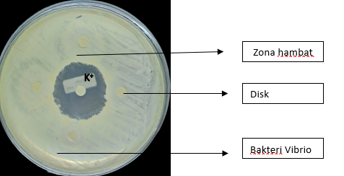
Shrimp diseases caused by Vibrio spp. remain a major constraint in aquaculture, necessitating the exploration of alternative antibacterial agents from natural sources. This study aimed to determine the proportion and antibacterial activity of bacterial isolates derived from the intestines of mantis shrimp. Samples were collected from Jepara, Pemalang, and Cilacap waters using a purposive sampling approach. The research methods included bacterial isolation, morphological characterization, and screening of antivibrio activity. Antibacterial activity was evaluated against Vibrio parahaemolyticus, Vibrio alginolyticus, and Vibrio harveyi using dotting and disc diffusion methods. The results showed that 27% of isolates from Jepara, 44% from Pemalang, and 16% from Cilacap exhibited antivibrio activity. The inhibition zones ranged from 1.1–11.0 mm against V. parahaemolyticus, 3.3–9.0 mm against V. alginolyticus, and 2.2–11.8 mm against V. harveyi. These findings indicate that intestinal bacteria of mantis shrimp from all sampling locations possess antibacterial activity against Vibrio spp., highlighting their potential as promising candidates for the development of biocontrol agents in sustainable aquaculture systems.
Downloads
References
Ahyong, S. T., Chan, T.-Y., & Liao, Y.-C. (2008). A catalog of the mantis shrimp (Stomatopoda) of Taiwan. National Taiwan Ocean University. https://www.vliz.be/imisdocs/publications/245752.pdf
Annisa, N., Sarjito, & Prayitno, S. B. (2015). Pengaruh perendaman ekstrak daun sirih (Piper betle) dengan konsentrasi yang berbeda terhadap gejala klinis, kelulushidupan, histologi, dan pertumbuhan udang vaname (Litopenaeus vannamei) yang diinfeksi Vibrio harveyi. Journal of Aquaculture Management and Technology, 4(3), 54–60. https://ejournal3.undip.ac.id/index.php/jamt/article/view/9463/9189
Ardiani, U. (2011). Analisis keberagaman genetik gen 16S rRNA dan karakterisasi fisiologis bakteri asal usus udang vaname (Litopenaeus vannamei) dari berbagai umur (Skripsi). Institut Pertanian Bogor.
Aryal, S. (2022). Kirby Bauer Disc Diffusion Method For Antibiotic Susceptibility Testing. Microbe Notes. https://microbenotes.com/kirby-bauer-disc-diffusion/
Atlas, R. M., & Bartha, R. (1993). Microbial ecology: Fundamentals and applications. Benjamin Cummings.
Ministry of National Development Planning/National Development Planning Agency (BAPPENAS). (2024). Indonesian biodiversity strategy and action plan (IBSAP) 2025–2045. BAPPENAS. https://lcdi-indonesia.id/wp-content/uploads/2025/02/IBSAP-2025-2045.pdf
Basir, B., Kariyanti, K., & Isnansetyo, A. (2023). Aktivitas antibakteri tumbuhan darat dan pesisir dari Sulawesi Selatan terhadap penyakit Vibrio. Marlin, 4(1), 49. http://dx.doi.org/10.15578/marlin.V4.I1.2023.49-56
Burgess, J. G., Boyd, K. G., Armstrong, E., Jiang, Z., Yan, L., Berggren, M., May, U., Pisacane, T., Granmo, Å., & Adams, D. R. (2003). The development of a marine natural product-based antifouling paint. Biofouling, 19(Suppl.), 197–205. https://doi.org/10.1080/0892701031000061778
Darajati, W., Pratiwi, S., Herwinda, E., Radiansyah, A. D., Nalang, V. S., Nooryanto, B., Rahajoe, J. S., Ubaidillah, R., Maryanto, I., Kurniawan, R., Prasetyo, T. A., Rahim, A., Jefferson, J., & Hakim, F. (2016). Indonesian biodiversity strategy and action plan 2015–2020. BAPPENAS.
Gonzalez-Pastor, R., Carrera-Pacheco, S. E., Zúñiga-Miranda, J., Rodríguez-Pólit, C., Mayorga-Ramos, A., Guamán, L. P., & Barba-Ostria, C. (2023). Current Landscape of Methods to Evaluate Antimicrobial Activity of Natural Extracts. Molecules (Basel, Switzerland), 28(3), 1068. https://doi.org/10.3390/molecules28031068
Fitri, F. A., Feliatra, F., & Yoswati, D. (2020). Sensitivity test of Vibrio sp. bacteria isolated from Dumai sea waters to antibiotics. Asian Journal of Aquatic Sciences, 3(2), 189–192. https://doi.org/10.31258/ajoas.3.2.189-192
Fu, X., He, J., Wang, J., Shen, F., Qiu, J., Chen, C., Zhang, D., & Guo, H. (2024). Specific gut bacterial taxa inhabited in healthy shrimp (Penaeus vannamei) confer protection against Vibrio parahaemolyticus challenge. Aquaculture, 579, 740192. https://doi.org/10.1016/j.aquaculture.2023.740192
Haliza, N., & Elviantari, A. (2024). Uji aktivitas antibakteri dari hepatopankreas lobster pasir dan lobster batu terhadap bakteri patogen. Journal of Tropical Bioresources and Biotechnology, 1(1), 8–12. https://jurnal.uts.ac.id/index.php/satonda/article/download/3863/1774
Hamidah, M. N., Rianingsih, L., & Romadhon, R. (2019). Aktivitas antibakteri isolat bakteri asam laktat dari peda terhadap E. coli dan S. aureus. Jurnal Ilmu dan Teknologi Perikanan, 1(2), 11–21. https://doi.org/10.14710/jitpi.2019.6742
Hitijahubessy, H., Samid, A., Kristiyanti Jalmaf, W., Hasanela, N., Huwae, L. M. C., & Perikanan Negeri Tual. (2022). Antibacterial activity of sernai leaves (Wedelia biflora) against Vibrio sp. Biofaal Journal, 3(1), 43–50. https://doi.org/10.30598/biofaal.v3i1pp43-50
Holt, J. G., Krieg, N. R., Sneath, P. H. A., Staley, J. T., & Williams, S. T. (2000). Bergey’s manual of determinative bacteriology. Lippincott Williams & Wilkins.
Hoover, D. G., & Steenson, L. R. (1993). Bacteriocins of lactic acid bacteria. Academic Press.
Ihtifazhuddin, M. I., Nursyam, H., & Ekawati, A. W. (2016). The influence of fermentation time in the physical and chemical composition of fermented soybean husk by using Aspergillus niger on the quality of raw feed materials. The Journal of Experimental Life Science, 6(1), 52-57. https://doi.org/10.21776/ub.jels.2016.006.01.12
Ilyas, S. (2001). Mikrobiologi dasar: Diklat kompilasi 28. Universitas Sumatera Utara Press.
Helmiyati F. A., & Nurrahman. (2010). Pengaruh konsentrasi tawas terhadap pertumbuhan bakteri Gram positif dan negatif. Jurnal Pangan dan Gizi, 1(1), 1–6. https://media.neliti.com/media/publications/116514-ID-pengaruh-konsentrasi-tawas-terhadap-pert.pdf
Imada, C., Koseki, N., Kamata, M., Kobayashi, T., & Hamada-Sato, N. (2007). Isolation and characterization of antibacterial substances produced by marine actinomycetes. Actinomycetologica, 21(1), 27–31. https://doi.org/10.3209/saj.SAJ210104
Jawetz, E., Melnick, J. L., & Adelberg, E. A. (1996). Mikrobiologi kedokteran (Medical microbiology) (Alih bahasa oleh I. Setiawan, R. F. Maulany, E. Nugroho, & M. Aldeburg). EGC.
Jiwintarum, Y., Diarti, M. W., & Zaeniati, B. L. (2021). Variasi suhu inkubasi mempengaruhi jumlah sel vegetatif dan spora Bacillus sphaericus. Poltekita: Jurnal Ilmu Kesehatan, 15(1), 76–83. https://doi.org/10.33860/jik.v15i1.415
Kaemudin, K., Erlina, A., & Taslihan, A. (2016). Aplikasi ekstrak allisin untuk pengendalian penyakit kotoran putih pada udang vaname (Litopenaeus vannamei) di Balai Besar Perikanan Budidaya Air Payau Jepara. In Prosiding Seminar Nasional Tahunan Ke-V Hasil Penelitian Perikanan dan Kelautan (pp. 257–262). https://eprints.undip.ac.id/51283/1/B2_11(31).pdf
Lalamentik, G. J., Wewengkang, D. S., & Rotinsulu, H. (2017). Aktivitas antibakteri ekstrak karang lunak Klyxum sp. yang diperoleh dari Teluk Manado. PHARMACON, 6(3), 46–56. https://doi.org/10.35799/pha.6.2017.16549
Lesel, R. (1990). Thermal effects on bacteria in the gut of rainbow trout and African catfish. In R. Lesel (Ed.), Microbiology in poikilotherms (pp. 33–38). Elsevier.
Lestari, Y., Ardiningsih, P., & Nurlina. (2016). Aktivitas antibakteri Gram positif dan negatif dari ekstrak dan fraksi daun nipah (Nypa fruticans Wurmb.) asal pesisir Sungai Kakap Kalimantan Barat. Jurnal Kimia Khatulistiwa, 5(4), 1–8. https://jurnal.untan.ac.id/index.php/jkkmipa/article/view/16274/14156
Luangtrakul, W., Boonchuen, P., Jaree, P., Kumar, R., Wang, H.-C., & Somboonwiwat, K. (2021). Cytotoxicity of Vibrio parahaemolyticus AHPND toxin on shrimp hemocytes, a newly identified target tissue, involves binding of toxin to aminopeptidase N1 receptor. PLOS Pathogens, 17(3), e1009383. https://doi.org/10.1371/journal.ppat.1009463
Luthfiani, L., Ghofar, A., & Purwanti, F. (2018). Komposisi jenis ikan hasil tangkapan sampingan (bycatch) pukat dorong di tambak lorok, semarang. Management of Aquatic Resources Journal (MAQUARES), 7(3), 288-297. https://ejournal3.undip.ac.id/index.php/maquares
Madigan, M. T., Martinko, J. M., & Brock, T. D. (2006). Brock biology of microorganisms. Pearson Prentice Hall.
Marbun, J., Harpeni, E., & Wardiyanto, W. (2019). Penanganan penyakit white feces pada udang vaname (Litopenaeus vannamei) menggunakan aplikasi pakan yang dicampur ekstrak lengkuas merah (Alpinia purpurata K. Schum.). Depik, 8(2), 76–86. https://doi.org/10.13170/depik.8.2.13570
Martsiningsih, A., Suyana, S., Noviani, A., Rahmawati, U., Sujono, S., & Dwi Astuti, F. (2023). Pengaruh waktu inkubasi terhadap diameter zona hambat antibiotik pada uji sensitivitas bakteri Klebsiella pneumoniae. Meditory: The Journal of Medical Laboratory, 11(1), 1–8. https://doi.org/10.33992/meditory.v11i1.2361
Mayaserli, D. P., & Shinta, D. Y. (2021). Uji daya hambat dan daya bunuh ekstrak buah mengkudu (Morinda citrifolia Linn.) terhadap pertumbuhan bakteri Staphylococcus aureus. Jurnal Kesehatan Perintis (Perintis's Health Journal), 8(1), 67–74. https://doi.org/10.33653/jkp.v8i1.622
Morales, G., Sierra, P., Mancilla, A., Paredes, A., Loyola, L. A., Gallardo, O., & Borquez, J. (2003). Secondary metabolites from four medicinal plants from northern Chile: Antimicrobial activity and biotoxicity against Artemia salina. Journal of the Chilean Chemical Society, 48(2), 13–18. http://dx.doi.org/10.4067/S0717-97072003000200002
Pamungkas, N. D., Firmansyah, A., & Ethica, S. N. (2018). Isolasi dan uji patogenitas bakteri indigen penghasil enzim selulase dari limbah ampas kelapa di pasar tradisional Ngawen untuk bioremediasi. In Prosiding Seminar Nasional Mahasiswa Universitas Muhammadiyah Semarang (Vol. 1, pp. 261–267). https://prosiding.unimus.ac.id/index.php/mahasiswa/article/view/155
Pratama, P. N., Prayitno, S. B., & Sarjito. (2014). Pemanfaatan ekstrak daun binahong untuk penanggulangan penyakit bakteri pada udang windu. Journal of Aquaculture Management and Technology, 3(4), 281–288. https://ejournal3.undip.ac.id/index.php/jamt/article/view/7344
Pratiwi, S. T. (2008). Mikrobiologi farmasi. Penerbit Erlangga.
Radjasa, O. K., Marten, T., Brinkoff, T., Grossart, H.-P., Sabdono, A., & Simon, M. (2004). Antibacterial activity of coral-associated bacteria. Journal of Coastal Development, 7(2), 141–147. https://ejournal.undip.ac.id/index.php/coastdev/article/view/969/832
Radji, M. (2019). Buku ajar mikrobiologi: Panduan mahasiswa farmasi & kedokteran (J. Manurung, Ed.). Penerbit Buku Kedokteran EGC.
Rakasiwi, D., Astuti, W., & Marliana, E. (2023). Potensi antibakteri ekstrak etanol meniran (Phyllanthus niruri L.) terhadap bakteri Streptococcus sobrinus dan Salmonella typhi. Jurnal Atomik, 8(1), 23–27. https://jurnal.kimia.fmipa.unmul.ac.id/index.php/JA/article/view/1204
Rinihapsari, E., Onesiforus, B. Y., & Nugroho, S. M. (2023). Pengaruh pemanasan berulang media nutrient agar terhadap hasil uji sensitivitas. Antigen: Jurnal Kesehatan Masyarakat dan Ilmu Gizi, 1(3), 18–26. https://doi.org/10.57213/antigen.v1i3.191
Safrida, Y. D., Yulvizar, C., & Devira, C. N. (2012). Isolasi dan karakterisasi bakteri berpotensi probiotik pada ikan kembung (Rastrelliger sp.). Depik, 1(3), 200–203. https://doi.org/10.13170/depik.1.3.124
Sari, N. P., Sari, R., & Untari, E. K. (2018). Antibacterial activity test of bacteriocin from Lactobacillus brevis, Lactobacillus casei, and Lactobacillus plantarum against Gram-positive pathogenic bacteria. Journal of Tropical Biodiversity and Biotechnology, 3(3), 85. https://doi.org/10.22146/jtbb.38138
Sinatryani, D. (2014). Kelimpahan bakteri selulolitik di muara Sungai Gunung Anyar Surabaya dan Bancaran Bangkalan (Undergraduate thesis). Universitas Airlangga.
Situmeang, S. M. F., Musthari, & Riadi, S. (2017). Isolasi dan uji aktivitas antimikroba bakteri asam laktat (BAL) dari yoghurt dalam menghambat pertumbuhan bakteri Escherichia coli dan Salmonella typhi. Jurnal Biosains, 3(3), 144–152. https://doi.org/10.24114/jbio.v3i3.8302
Soleha, T. U. (2019). Uji kepekaan terhadap antibiotik. JuKe Unila, 5(9), 119–123. https://juke.kedokteran.unila.ac.id/index.php/juke/article/view/644
Sukenda, Wahjuningrum, D., Widanarni, & Kurniawinata, M. I. (2022). Struktur komunitas mikrobiota usus udang vaname (Penaeus vannamei) dan media pemeliharaan selama wabah white feces disease. Institut Pertanian Bogor.
Suryani, S., & A’yun, Q. (2022). Isolasi bakteri endofit dari mangrove Sonneratia alba asal Pondok 2 Pantai Harapan Jaya Muara Gembong, Bekasi. Bio-Sains: Jurnal Ilmiah Biologi, 1(2), 12–18. https://doi.org/10.6084/m9.figshare.23564679
Taslihan, A., Fairus, M., & Supito, S. (2015). Petunjuk teknis pengendalian penyakit berak putih (white feces disease) pada udang vaname di tambak. Direktorat Jenderal Perikanan Budidaya, Kementerian Kelautan dan Perikanan.
Tokasaya, P. (2010). Sponge-associated bacteria producing antimicrobial compounds and their genetic diversity analysis (Thesis). Bogor Agricultural University.
Tran, L., Nunan, L., Redman, R. M., Mohney, L. L., Pantoja, C. R., Fitzsimmons, K., & Lightner, D. V. (2013). Determination of the infectious nature of AHPND. Diseases of Aquatic Organisms, 105(1), 45–55. https://doi.org/10.3354/dao02621
Van Haren, F. M. P., Foudraine, N., & Gillham, M. (2007). Infection and sepsis. Elsevier. https://doi.org/10.1016/B978-075067572-7.50038-2
Waluyo, L. (2009). Mikrobiologi lingkungan. UMM Press.
Walewangko, G. V. C., Bodhi, W., & Kepel, B. J. (2015). Uji resistensi bakteri Escherichia coli yang diisolasi dari plak gigi menggunakan merkuri dan ampisilin. Jurnal e-Biomedik, 3(1). https://doi.org/10.35790/ebm.v3i1.6634
Wibowo, M. H., Nugroho, W. S., & Asmara, W. (2011). Profil plasmid Escherichia coli resisten terhadap beberapa antibiotika yang diisolasi dari peternakan ayam komersial. Jurnal Sain Veteriner, 29(1), 43–50. https://doi.org/10.22146/jsv.290
Widanarni, W., Wahjuningrum, D., & Puspita, F. (2012). Aplikasi bakteri probiotik melalui pakan buatan. Jurnal Sains Terapan, 2(1), 19–29.
Wiguna, A. S., Kusmita, L., & Radjasa, O. K. (2016). Uji aktivitas antibakteri pigmen karotenoid dari isolat bakteri simbion karang lunak Sarcophyton sp. Indonesian Journal of Pharmaceutical Science and Technology, 3(3), 92–98. https://doi.org/10.15416/ijpst.v3i3.9176
Wijayanto, U. (2009). Analisis in vitro toleransi isolat bakteri asam laktat asal daging sapi terhadap pH lambung, pH usus, dan garam empedu sebagai kandidat probiotik (Undergraduate thesis). Institut Pertanian Bogor.
Wulandari, D. (2013). Pengaruh pemberian probiotik terhadap penurunan bahan organik dalam air media pertumbuhan udang vannamei (Litopenaeus vannamei) di BBPBAP Jepara (Undergraduate thesis). Universitas PGRI Semarang.
Zorriehzahra, M. J., & Banaederakhshan, R. (2015). Early mortality syndrome (EMS) as an emerging threat. Advances in Animal and Veterinary Sciences, 3(2), 64–72. https://doi.org/10.14737/journal.aavs/2015/3.2s.64.72
Downloads
Published
Issue
Section
License
Copyright (c) 2026 Navita Desy Ratnaningsih, Petrus Hary Tjahja Soedibya, Jefri Anjaini (Author)

This work is licensed under a Creative Commons Attribution-ShareAlike 4.0 International License.